(Page 10 of 41)
God Creates Life on Earth
Origins Page 53
- Energy: Determined by frequency, expressed by the equation E = hf, where h is Planck’s constant.
Explanation for E = hf
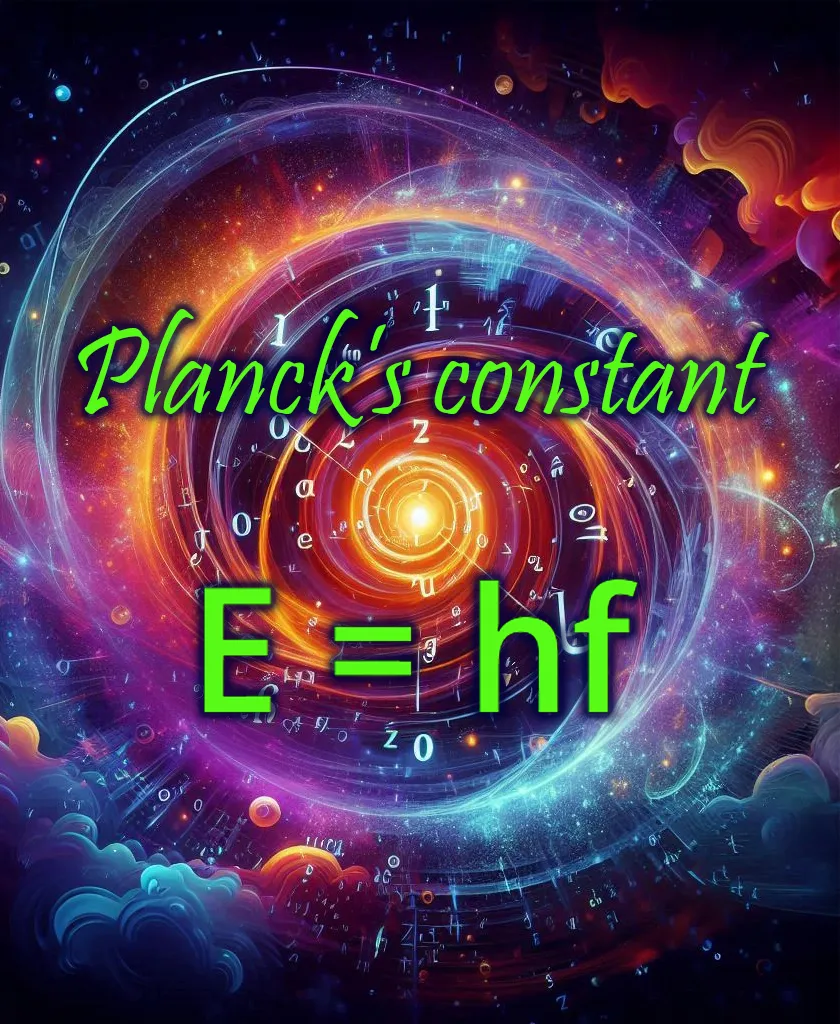
The relationship E = hf is one of the most important equations in quantum physics. It defines how the energy (E) of a photon — the fundamental particle of light — depends directly on its frequency (f). The constant of proportionality, Planck’s constant (h = 6.626 × 10⁻³⁴ joule-seconds), is an extremely small value that sets the scale of quantum effects and governs how energy is  quantized in light.
In simple terms, this means that higher-frequency radiation, such as ultraviolet or X-rays, carries more energetic photons capable of causing greater effects, while lower-frequency radiation, such as infrared or radio waves, carries less energetic photons.

This relationship explains why ultraviolet light can cause sunburn while visible light cannot — its photons have greater energy due to their higher frequency and stronger ability to penetrate our skin.
Thus, E = hf reveals the quantized nature of light, showing that electromagnetic energy is not continuous but delivered in discrete packets — photons — each carrying an exact amount of energy determined by its frequency.
Types of Photons
-
Visible Light: The photons
 that make up the sunlight we see, with varying frequencies corresponding to different colors.
- Other Radiation: Includes infrared photons (heat), ultraviolet photons (which can cause sunburn), and higher-energy photons like X-rays and gamma rays.

Wave–Particle Duality

- Wave Behavior: A photon can spread out like a wave. This is seen in phenomena such as diffraction (light bending around corners) and interference (light waves combining, creating patterns of bright and dark fringes). It is described by wave properties like wavelength (λ) and frequency (ν).
-
Particle Behavior: When measured, the photon appears as a discrete particle — a single quantum of light. This particle-like nature is demonstrated by the photoelectric effect, where light striking a metal surface ejects electrons,
 an effect only explained by particle theory. The energy (E) of this particle is directly proportional to the wave’s frequency, as described by the Planck-Einstein relation: E = hν, where h is Planck's constant.