(Page 6 of 41)
God Creates Life on Earth
Origins Page 49
divine law into energy, perfectly balanced to maintain life on Earth.
Understanding the Number
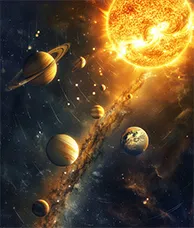
The Sun’s luminosity is its total power output — the immense energy released every second. In simple terms, the Sun produces about 380 trillion trillion watts each second, flooding the Solar System with radiant light and sustaining warmth, and fueling every dynamic process that makes life on Earth possible.
To appreciate this staggering figure, consider the comparison:

- A typical household light bulb uses about 100 watts (that’s 0.0001 megawatts).
- The Sun radiates about 3.8 × 10²⁰ megawatts — enough to power billions of trillions of light bulbs simultaneously, illuminating the heavens and energizing the delicate balance of our planetary system.
The Sun’s Gift to Earth
On Earth, this incredible energy powers photosynthesis, drives weather patterns, and supports  every living process. Its life-giving warmth and light bring comfort to all creatures, nurturing growth, vitality, and the delicate balance of life across the planet — a radiant testimony to God’s divine precision and sustaining care.
The Dissipation of Solar Energy
As sunlight and heat radiate outward from the Sun, their intensity steadily decreases. Because solar energy spreads in all directions, it weakens  with distance according to the inverse-square law. This means that as the distance from the Sun doubles, the amount of energy received becomes four times weaker. The result is a graceful decline in temperature and brightness across the Solar System — a display of God’s concise design of physical precision and divine order.
Mercury: The Hottest Planet of the Solar System
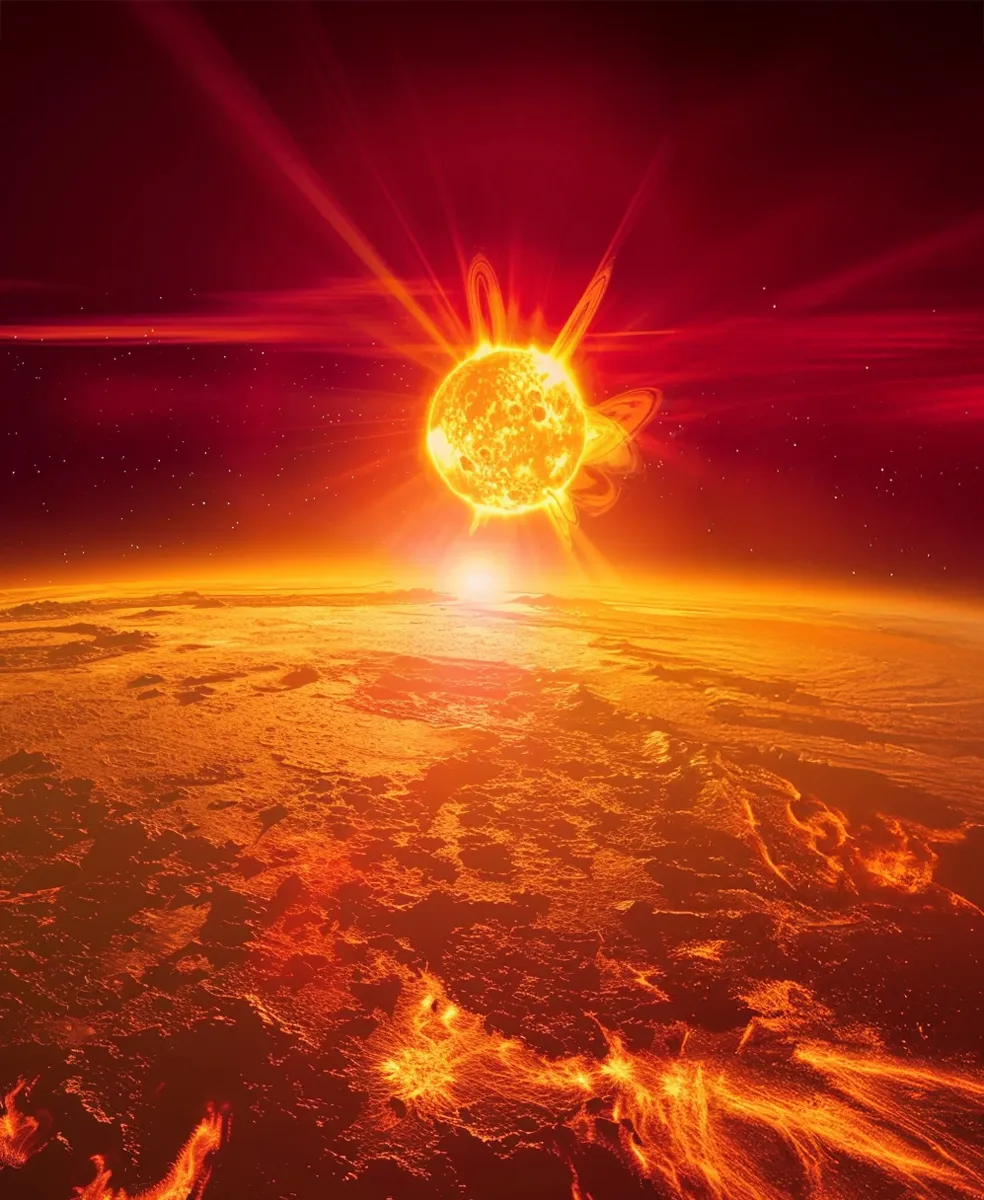
Near Mercury, the closest planet to the Sun at an average distance of about 58 million kilometers (36 million miles), the Sun’s brilliance is fierce, and the planet endures searing extremes. Daytime surface temperatures can soar above 430°C (800°F) under the relentless glare, while nights plunge to –180°C (–290°F) in the absence of an atmosphere to retain heat. Here, the Sun dominates every horizon — a blazing cauldron of Creation at its most intense.
Earth: Perfectly Balanced for Life
Earth, the third planet from the Sun after Mercury and Venus, orbits at an average distance  of about 150 million kilometers (93 million miles) from the Sun, receiving roughly 1,361 watts of solar energy per square meter at the top of its atmosphere — a balance perfectly suited to sustain abundant life. This region lies within the “